If you spend any time in HR circles, you’ve probably heard the terms Workforce Planning (WFP) and Workforce Management (WFM) used interchangeably. On the surface, they sound like synonyms. But in reality, confusing these two functions is a quick path to either chaotic overstaffing or strategic paralysis.
Here is the simplest way to put it: Planning is about the future. Management is about the present.
One helps you build a strategy for the next three years; the other helps you make sure the store opens on time tomorrow morning. While both are critical, HR teams fail when they treat them as the same thing.
Let’s break down the key differences—and why your HR strategy needs both to survive.
The Core Distinction: Strategy vs. Tactics
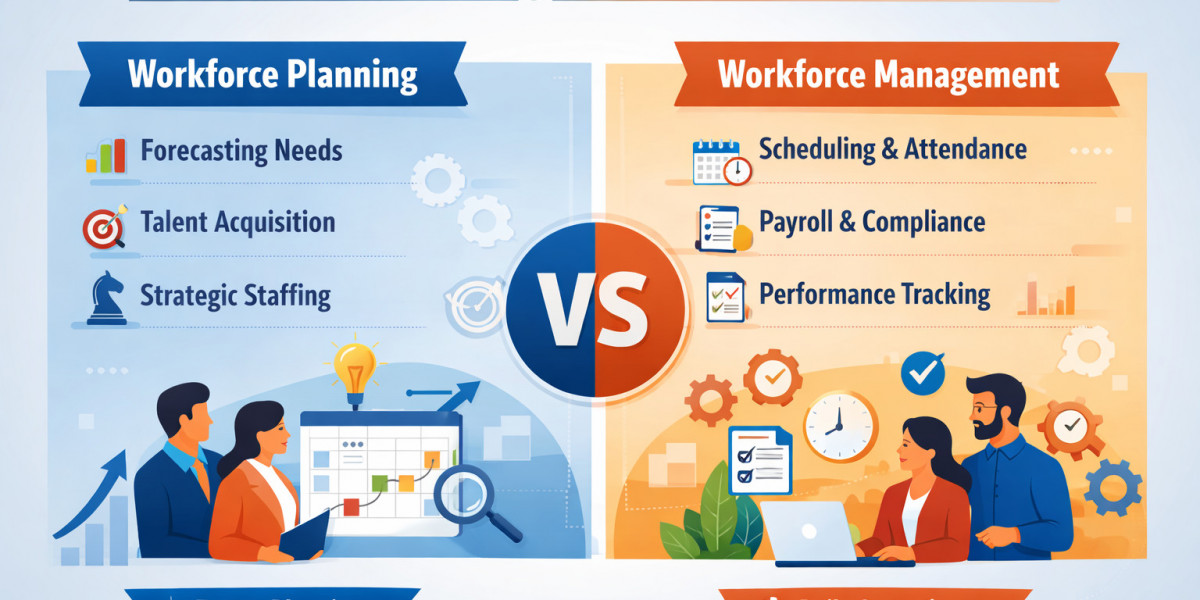
Workforce Planning is a strategic, long-term process. It answers the question: “Do we have the right people, with the right skills, in the right locations, to meet our future business goals?”
Time horizon: 6 months to 5+ years.
Focus: Skills gaps, succession planning, future hiring needs, and automation risks.
Output: A strategic roadmap for recruiting, upskilling, and restructuring.
Workforce Management is an operational, daily process. It answers the question: “Are the people we currently have working efficiently and compliantly right now?”
Time horizon: Today, this week, or this pay period.
Focus: Scheduling, time & attendance, absence tracking, and labor law compliance.
Output: Optimized shift schedules, accurate payroll data, and real-time coverage.
The "Ship Captain" Analogy
Imagine you are the captain of a cargo ship.
Workforce Planning is your navigation chart. You look at the weather forecast, fuel range, and crew certifications. You decide you need to hire two more engineers before the winter season because you know the rough seas will cause breakdowns.
Workforce Management is the daily duty roster. You decide who is steering from 2 AM to 6 AM, who is on break, and who is covering for the sick deckhand.
If you only plan, you have a beautiful map but no one awake at the wheel. If you only manage, you might have a full crew working hard—sailing in the wrong direction.
Where HR Teams Get Stuck
The biggest failure point for HR is siloing.
Often, a Strategic HRBP does the workforce planning once a year, hands a headcount report to the recruiting team, and walks away. Meanwhile, the Operations or Payroll team handles workforce management using a completely different set of tools and data.
The result? You plan to hire 10 senior developers (strategic need), but your WFM system shows you currently have 15 junior developers sitting idle due to bad scheduling (operational waste). You are solving a problem you don't actually have.
Key Differences at a Glance
| Feature | Workforce Planning (WFP) | Workforce Management (WFM) |
|---|---|---|
| Primary Goal | Future readiness & skill gaps | Daily efficiency & cost control |
| Key Metric | Right skills, Right time, Right cost | Utilization rate, Overtime %, Shrinkage |
| HR Activity | Succession planning, Talent mapping | Shift bidding, Time tracking, PTO approval |
| Data Source | Business forecasts, Market trends | Time clocks, Schedules, Absence logs |
| Consequence of failure | You can't grow or pivot | You violate labor laws or burn out staff |
How to Bridge the Gap (The "Actionable" Advice)
You cannot choose one over the other. You must integrate them. Here is how mature HR teams connect the dots:
1. Use WFM data to inform WFP
Don't guess your future needs. Look at your current WFM data. If your WFM system shows 40% overtime for the last six months, your workforce plan should include hiring more full-time staff, not just blaming the manager for bad schedules.
2. Build flexible "Skill Swarms"
Traditional WFM schedules people into rigid job codes. Modern HR uses WFP to create "skill inventories." When a WFM schedule has a gap (e.g., "no cashier for 3 PM"), the system should pull from the WFP skill bank (e.g., "John in inventory is cross-trained for checkout").
3. Review planning quarterly, not annually
The days of the annual headcount plan are over. HR teams should revisit their workforce plan every 90 days based on the operational realities coming out of their WFM software.
The Bottom Line
Workforce Planning asks "Where are we going?" Workforce Management asks "Who is working right now?"
If you are an HR leader, look at your calendar. If you spend 90% of your time on scheduling, time clocks, and backfill (WFM), you are too tactical. If you spend 90% of your time on competency models and five-year forecasts (WFP), you are too theoretical.
The magic happens when your daily schedules automatically feed your long-term strategy.